xuye
xuye全站搜索
Search the entire website
整站搜索产品中心新闻中心
点击开始搜索
热门搜索
UltraForm-MXFlexiPoly-RNanoForm Z300EcoFab P200
Search the entire website
Scope of application
In the field of flexible electronics, it is used for low-temperature deposition of indium tin oxide (ITO) transparent conductive films on polyimide (PI) substrates; for the preparation of silicon nitride vibration membrane layers in MEMS sensor manufacturing; and for the coating deposition of core-shell structures in quantum dot devices. Its technological breakthroughs are reflected in multi-plasma source coupling (RF/DC/microwave coordination), in-situ monitoring (optical emission spectroscopy (OES)), and precise atmosphere control (reaction gas ratio, pressure gradient).
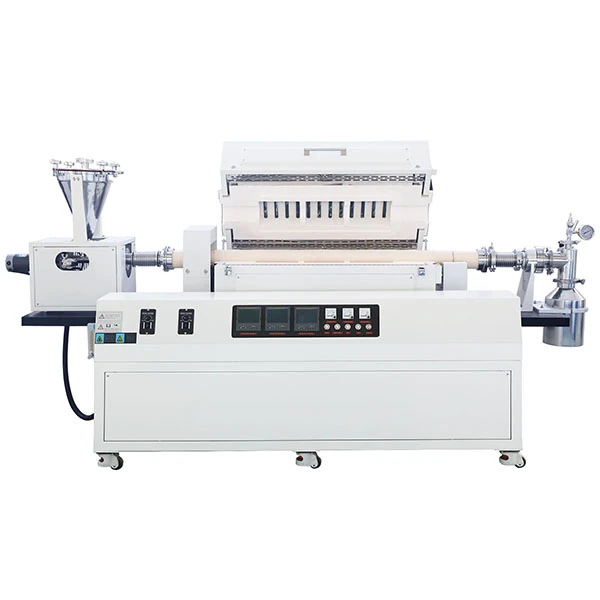
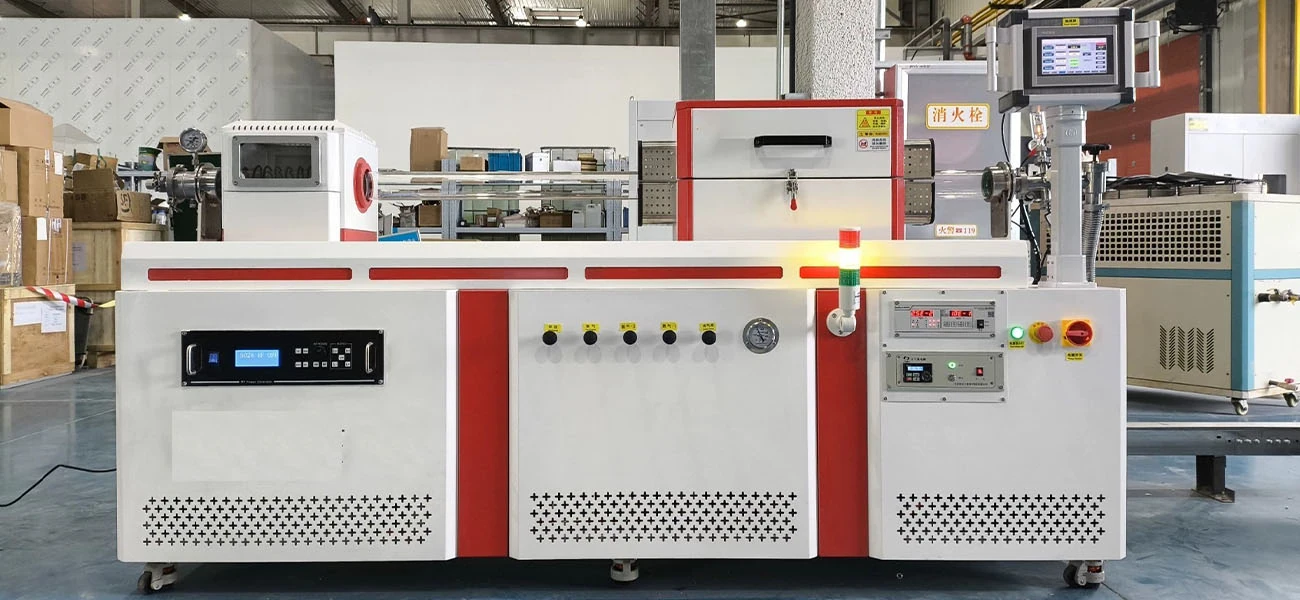
A PECVD tube furnace (Plasma-Enhanced Chemical Vapor Deposition Tube Furnace) is a deposition system that combines plasma excitation with a heated tubular reaction chamber. It utilizes high-frequency radio frequency (RF) or microwave power to generate plasma within the reaction chamber, decomposing and activating the precursor gas. This enables thin film deposition even at relatively low substrate temperatures (typically 100–400°C).
Compared to traditional thermal CVD, PECVD offers the following key advantages:
Low-temperature deposition (lower than 200°C)
High deposition rate
Dense film quality and excellent adhesion
Ability to deposit temperature-sensitive substrates (such as plastics and optical polymers)
Typical applications include:
Semiconductor passivation layers (Si₃N₄, SiO₂)
Photovoltaic thin films (a-Si:H, transparent conductive films)
Optical coatings
Hard and wear-resistant coatings (DLC, TiN)
Corrosion protection and barrier films
PECVD Process Principle
The core principle of PECVD is to introduce process gases into a tube furnace and generate plasma using radio frequency (commonly 13.56 MHz) or microwave power. This ionizes and activates gas molecules or free radicals, enabling chemical reactions at relatively low substrate temperatures and deposition as a solid film.
Main Process:
Gas Introduction
Precursor gases (such as SiH₄, NH₃, CH₄, CF₄, etc.) are mixed with inert gases (Ar, He)
Precisely proportioned using a mass flow controller (MFC)
Plasma Excitation
RF or microwave source generates glow discharge in the reaction zone
Generates active species such as electrons, ions, and free radicals
Surface Reaction and Film Formation
Activated species reach the substrate surface, adsorb, and participate in chemical reactions
Forms a dense, uniform film
Byproduct Exhaust
Gaseous byproducts (such as H₂, NH₃, CO₂) generated by the reaction are exhausted via a vacuum pump
Purified by the exhaust gas treatment system before discharge
PECVD Tube Furnace Structure
Heating Furnace
Single/Dual/Triple Zone Heating
PID Temperature Control (±1–±2°C) Accuracy)
Insulation material: Lightweight ceramic fiber
Furnace tube
Commonly used: quartz tube (SiO₂) or corundum tube (Al₂O₃)
Diameter Φ40–150 mm, length 800–1500 mm
Gas system
Multi-channel MFC (0–200 sccm / 0–1 slm)
Gas mixing manifold, needle valve, check valve
Plasma generation system
RF power supply (13.56 MHz, 100–600 W) + matching network
Or microwave power supply (2.45 GHz)
Electrode structure: Parallel plate / annular / coaxial
Vacuum system
Mechanical pump or dry pump
Back pressure valve + capacitance diaphragm vacuum gauge (accuracy ±0.1 mTorr)
Exhaust Gas Treatment
Burner, Acid/Base Scrubber, Activated Carbon Adsorption Tower
Safety System
Gas Leak Detection (H₂, SiH₄, NH₃)
Overtemperature, Overpressure, and Discharge Interlock
Emergency Stop Switch
PECVD Tube Furnace Workflow
Sample Loading: Place the substrate in the center of the furnace tube and secure it to the sample holder.
Evacuation/Displacement: Evacuate to a set vacuum (e.g., 50 mTorr) or replace with Ar/N₂.
Steady-State Temperature Ramp: Heat to a set temperature (100–400°C).
Gas Feed: Turn on the MFC to supply the reaction and carrier gases.
Plasma Start: Turn on the RF/microwave power supply and adjust the power to achieve a stable discharge.
Deposition Reaction: Maintain the set temperature, pressure, gas flow, and power for a period of time.
Shut Off the Plasma/Introduce Inert Gas: Terminate the reaction and prevent oxidation.
Cooling/Sampling: Remove the substrate after cooling to a safe temperature.
| Model | YX-1200P |
| Rated total power | 3.2KW (heating furnace: 2.6KW, radio frequency unit: 0.15KW, vacuum unit: 0.45KW) |
| Maximum temperature | 1200℃ |
| Continuous operating temperature | ≤1100℃ |
| Recommended heating rate | ≤10°C/min |
| Temperature measuring element | K-type thermocouple |
| Heating zone length | Dual independent heating zones: 230mm + 230mm |
| Furnace tube dimensions | Φ50 x 1900mm |
| Temperature control method | FFuzzy PID control and auto-tuning, intelligent 30-segment programmable control, over-temperature and burnout alarms |
| Temperature control accuracy | ±1°C |
| Heating element | Resistance wire |
| RF power | 150W |
Online Message