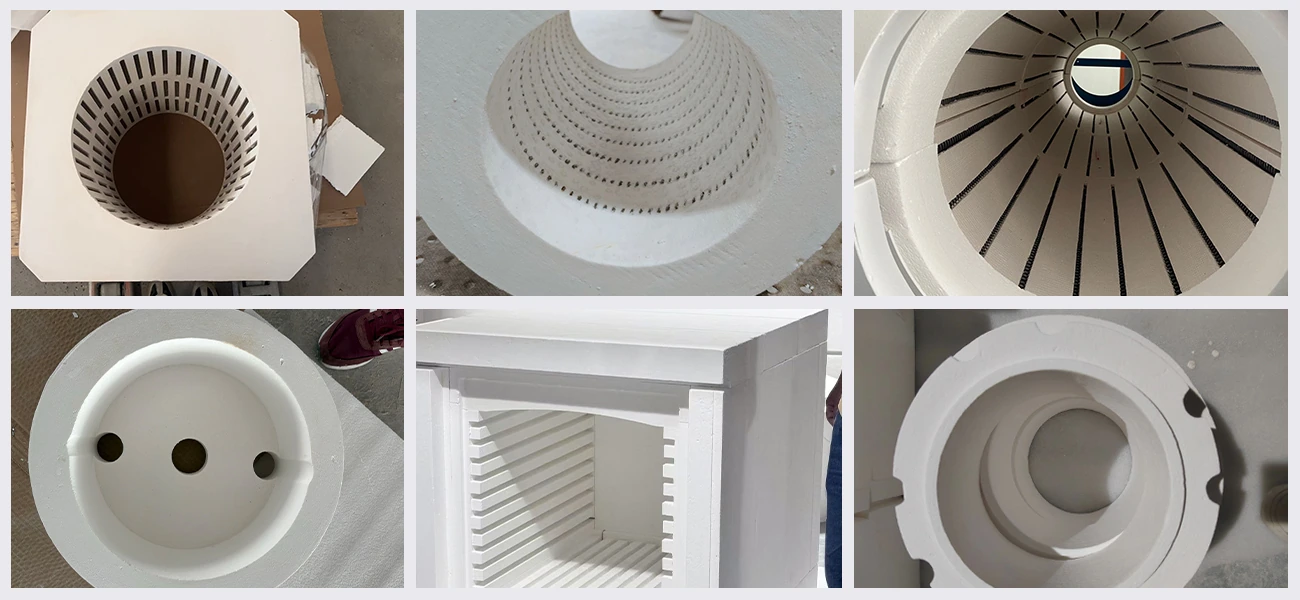
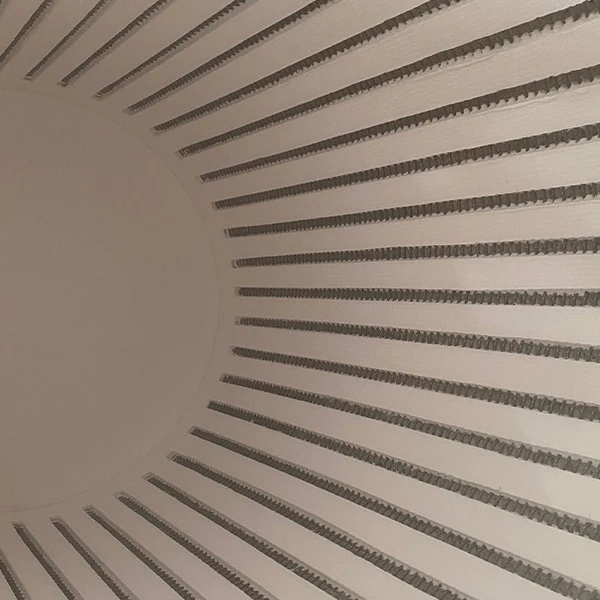
Ceramic fiber heating module is a high-efficiency thermal insulation heating integrated component that integrates ceramic fiber and electric heating elements. It is widely used in various muffle furnaces, tube furnaces, and industrial electric furnaces.
TEL+8618836556085
ceramic fiber module is a refractory insulation lining unit made from alumina-silica ceramic fiber, folded or stacked, and integrated with anchoring systems. It features low thermal conductivity, low heat storage, fast installation, and easy maintenance, making it an ideal choice for heat treatment furnaces, reheating furnaces, annealing furnaces, ceramic kilns, petrochemical cracking furnaces, glass furnaces, and electric furnaces.
Key Features
Low Thermal Conductivity: Ensures excellent insulation between 800–1200°C, reducing energy consumption (keywords: energy saving insulation, thermal efficiency).
Low Heat Storage: Faster heating and cooling cycles, minimizing energy loss (keywords: fast heat-up, low heat storage).
Modular Installation: Pre-assembled modules with L / Y / T-type anchors, easy to replace or repair (keywords: anchor system, modular lining).
Excellent Thermal Shock Resistance: Stable under harsh atmospheres (keywords: thermal shock resistance, chemical stability).
Operating Temperature & Atmosphere – Select standard, high-alumina, or zirconia fiber depending on furnace environment.
Thermal Gradient – Adjust thickness to ensure safe backing temperature.
Gas Velocity & Erosion – Choose folded modules or apply surface coating.
Anchoring Material – 304 for <1000°C, 310S / 601 for >1000°C.
Maintenance Plan – Keep spare modules of the same specification for quick replacement.
Installation Guidelines
Prepare furnace shell and weld studs or rails.
Install modules with staggered joints (≥50% overlap).
Ensure fiber direction is perpendicular to the hot face.
Fill gaps with ceramic fiber blanket or board.
Apply ceramic coating if needed for anti-dust and erosion resistance.
Follow recommended heating curve (bake-out) to avoid thermal shock.
FAQ (Frequently Asked Questions)
Q1: Is “ceramic fiber module” the same as “ceramic fibre module”? Yes, only spelling difference (US vs UK).
Q2: Can modules be used above 1400°C? Yes, zirconia-containing fiber modules are available, but continuous temperature should stay below classification temp.
Q3: Can modules be combined with castables or bricks? Yes, often used as backing insulation with castable or brick hot-face layers.
Q4: Do ceramic fiber modules generate dust? Slight dust may occur during installation or first heating. Surface coatings and bio-soluble fibers (AES) can reduce it.
Q5: How much energy can be saved? Typically 10–30% savings, depending on furnace design and operation cycle.
Ceramic fiber module technical parameters
Ceramic Fiber Heating Module
YX1260
YX1400
YX1500
YX1600
YX1700
YX1800
Working Temperature(℃)
1100
1200
1350
1500
1600
1700
Density(kg/m³)
300-600
300-600
300-600
300-600
450-700
450-700
Linear Shrinkage(24H) (After Burning) (%)
≤3.0 (1100℃)
≤3.0 (1250℃)
≤3.0 (1300℃)
≤1.0 (1450℃)
≤1.0 (1550℃)
≤1.0 (1650℃)
Thermal Conductivty Rate (W/m.k)
400℃
0.084
0.084
0.084
/
/
/
800℃
0.128
0.125
0.125
0.160
0.160
0.160
1000℃
0.176
0.174
0.200
0.210
0.210
0.210
Heating Element
Resistance wire
SiC heating element
SiC heating element
MoSi2 heating element
MoSi2 heating element
MoSi2 heating element
Furnace Chamber Size
Customized
Customized
Customized
Customized
Customized
Customized
The sizes and packaging can be customized according to your needs
 xuye
xuye