全站搜索

Search the entire website

Ceramic fiber insulation

Aluminum silicate fiber

Scope of application

aluminum silicate fiber also plays a key role in the fields of high-temperature sealing and fire safety due to its outstanding flexibility and fireproof properties. It is often processed into forms such as yarn, rope, cloth, and tape for wrapping and sealing high-temperature pipelines, valves, and flanges in the shipbuilding, chemical, and power industries.

TEL+8618836556085

Aluminum silicate fiber

Aluminum silicate fiber (also called alumina-silicate fiber or ceramic fiber) is a lightweight refractory insulation made from Al₂O₃–SiO₂ fibers. It combines low thermal conductivity, ultra-low heat storage, and excellent thermal shock resistance, making it ideal for industrial furnaces, kilns, heaters, boilers, incinerators, and lab equipment.

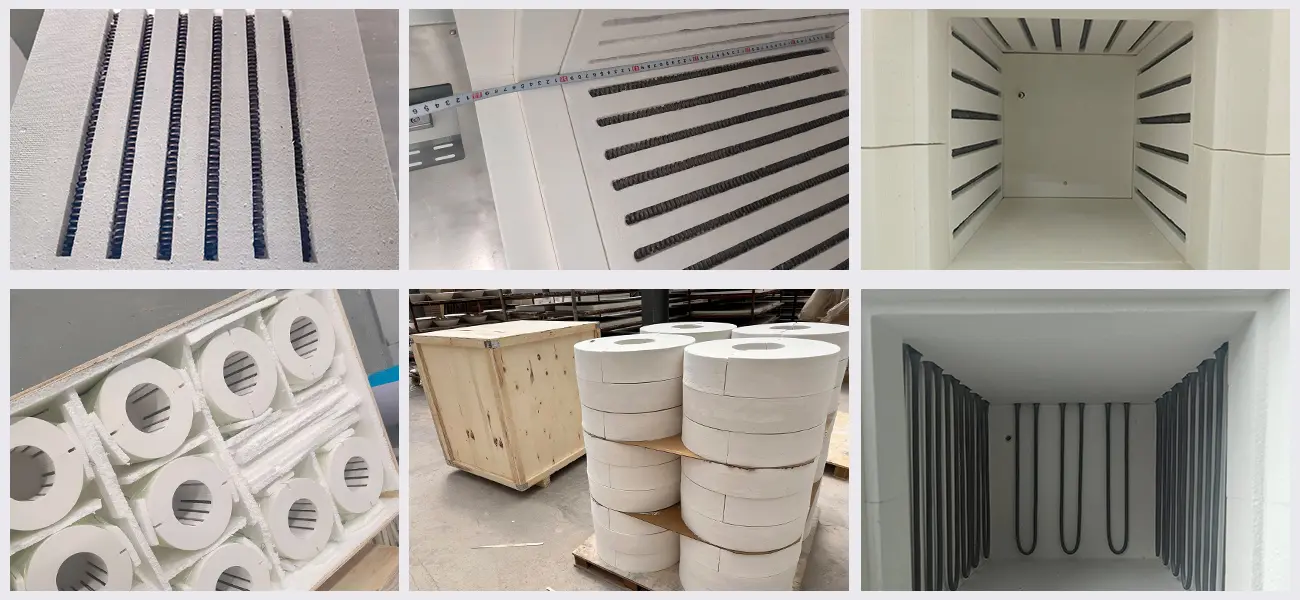
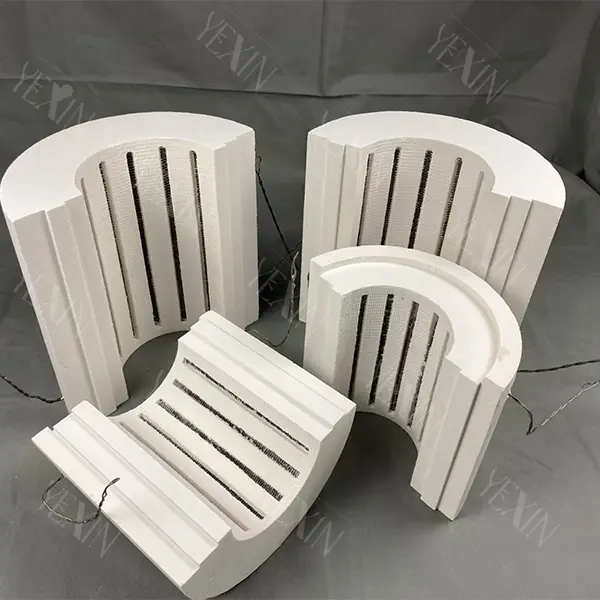
Ceramic fiber heating module

Why Choose Aluminum Silicate Fiber?

  • Energy saving: very low k-value reduces shell losses and fuel/electricity bills.
  • Fast cycling: minimal heat storage speeds up heat-up/cool-down for intermittent operations.
  • Lightweight: typical density 64–160 kg/m³; less load than bricks/castables.
  • Durable in harsh atmospheres: good thermal shock, erosion resistance (grade-dependent).
  • Easy installation: blankets, boards, and modules enable rapid lining and simple repairs.
  • Multiple grades: 1260°C / 1360°C / 1400°C / 1430°C (zirconia reinforced) for hot spots.


Product Forms (Cover All Search Intents)

  • Ceramic Fiber Blanket — needled blankets for wraps, backing layers, expansion joints.
  • Ceramic Fiber Board — rigid, vacuum-formed boards for flat hot faces and burner blocks.
  • Ceramic Fiber Paper / Gasket — thin sheets for seals, electrical isolation, anti-dust wraps.
  • Ceramic Fiber Module — pre-folded blocks for fast industrial lining with built-in anchors.
  • Ropes / Tapes / Sleeves — door seals, flanges, duct insulation.
  • Bulk Fiber & Vacuum Shapes — custom molded parts for complex components.


Typical Technical Data (Reference)

  • Classification temperature: 1260 / 1360 / 1400 / 1430°C
  • Recommended continuous service: up to 1000–1300°C (by grade)
  • Density: 64 / 80 / 96 / 128 / 160 kg/m³
  • Thermal conductivity (W/m·K): ~0.08–0.22 @ 200–1000°C
  • Linear shrinkage: ≤1–2% @ classification temp (24 h)
  • Standard sizes:
    • Blanket: 7–50 mm thick, 610 mm wide (or custom)
    • Board: 10–100 mm, 600×900 / 1000×1200 mm
    • Paper: 0.5–10 mm thickness, multiple widths
    • Module: 300×300 / 300×600 / 600×600 mm, 100–300 mm thick


Applications & Industries

  • Metals & Heat Treatment: quenching, tempering, annealing, brazing, sintering.
  • Steel & Non-ferrous: reheating/holding furnaces, aluminum melting/holding.
  • Ceramics & Glass: shuttle/tunnel/roller kilns, annealing lehrs, forehearths.
  • Petrochemical & Energy: cracking/reforming furnaces, heaters, boilers, incinerators.
  • Laboratory & Semiconductor: tube furnace, muffle furnace, CVD/PECVD systems (backing/hot-face).

Selection Guide (How to Specify)

  1. Temperature & Atmosphere: choose standard alumina-silicate for oxidizing atmospheres; zirconia-reinforced grades for 1400–1430°C class or hot spots.
  2. Form Factor: blanket for wraps/backing; board for rigid hot faces; paper for gaskets; module for fast large-area lining.
  3. Density & Thickness: higher density improves durability & lowers k-value; size thickness to meet target shell temperature.
  4. Anchoring: 304 for <1000°C; 310S / Incoloy / Inconel for >1000°C hot faces.
  5. Surface Treatment: ceramic coating/hardener for high gas velocity or abrasion.
  6. Compliance: consider AES bio-soluble grades where RCF restrictions apply.

Installation Best Practices

  • Clean shell; weld studs/rails to drawing.
  • Orient fibers perpendicular to the hot face for erosion resistance (boards/modules).
  • Stagger joints ≥50%; compress blankets to design density; fill gaps with matching fiber.
  • Use back-up insulation to control shell temperature.
  • Apply ceramic coating on the hot face if needed.
  • Follow a controlled bake-out curve to remove binders and minimize shrinkage.

Health & Safety (RCF vs AES)

  • Traditional RCF (refractory ceramic fiber) may be regulated; use PPE, dust control, and follow local HSE guidelines.
  • AES (alkaline earth silicate) bio-soluble fiber offers RCF-free options with easier compliance, typically suitable up to 1200–1260°C service.
  • H2|FAQ (Capture Featured Snippets)
  • Q1: Is aluminum silicate fiber the same as ceramic fiber?
  • Yes. The terms are often used interchangeably in the market.
  • Q2: What temperatures can it handle?
  • Classification 1260–1430°C; typical continuous service up to 1000–1300°C depending on grade.
  • Q3: Is there an RCF-free option?
  • Yes. AES bio-soluble fibers provide RCF-free alternatives for many applications.
  • Q4: Which form should I choose—blanket or board?
  • Blanket for wraps/backing and complex shapes; board for rigid hot faces and smooth surfaces.
  • Q5: Can it be used with castables or bricks?
  • Absolutely. Use hybrid linings: brick/castable on the hot face with ceramic fiber backing for best performance.

Ceramic fiber heating modules
Ceramic Fiber
Heating Module
YX1260YX1400YX1500YX1600YX1700YX1800
Working Temperature(℃)110012001350150016001700
Density(kg/m³)300-600300-600300-600300-600450-700450-700
Linear Shrinkage(24H)
(After Burning)
(%)
≤3.0
(1100℃)
≤3.0
(1250℃)
≤3.0
(1300℃)
≤1.0
(1450℃)
≤1.0
(1550℃)
≤1.0
(1650℃)
Thermal
Conductivty Rate
(W/m.k)
400℃0.0840.0840.084///
800℃0.1280.1250.1250.1600.1600.160
1000℃0.1760.1740.2000.2100.2100.210
Heating ElementResistance wireSiC heating elementSiC heating elementMoSi2 heating elementMoSi2 heating elementMoSi2 heating element
Furnace Chamber SizeCustomizedCustomizedCustomizedCustomizedCustomizedCustomized
The sizes and packaging can be customized according to your needs

Online Message

姓名*
公司
邮箱
电话
留言信息
正在提交!
提交成功!
提交失败!
邮箱错误!
电话错误!