 xuye
xuye全站搜索
Search the entire website
整站搜索产品中心新闻中心
点击开始搜索
热门搜索
UltraForm-MXFlexiPoly-RNanoForm Z300EcoFab P200
Search the entire website
Scope of application
Research institutions use it for preliminary sintering tests of new materials (such as ceramic glaze formula adjustment and nanopowder calcination), quickly verifying process feasibility through a compact uniform temperature zone ; in the jewelry processing field, it is used for precision annealing and impurity removal of precious metals (silver and platinum).
Compact benchtop muffle furnaces combine fast heat-up, stable temperature control, and simple airflow for repeatable LOI/ash workflows. Their insulated ceramic fiber chambers minimize energy use while multi-sided element layouts improve uniformity—key for method compliance and reproducibility.
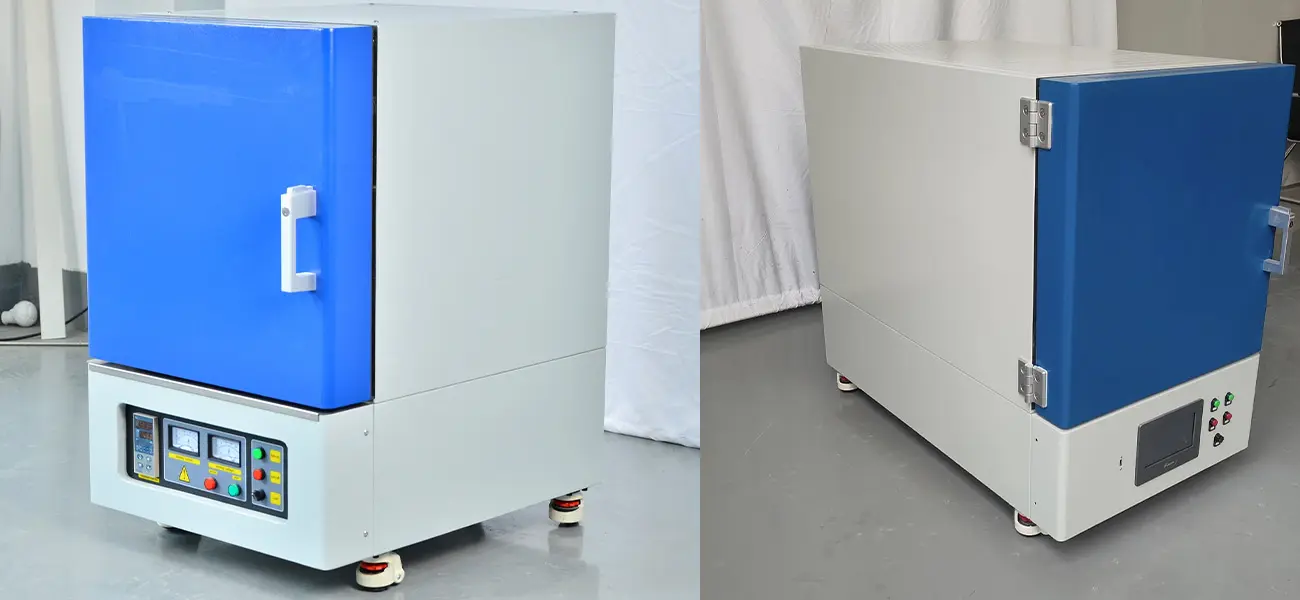
Always adjust to your governing standard and material.
A. LOI for organics (general):
B. Ashing of polymers/food:
C. Calcination of ceramic powders:
| Issue | Symptom | Root Cause | Action |
|---|---|---|---|
| Sooty residue | Incomplete ashing | Low oxygen / aggressive loading | Increase air inlet, reduce batch mass, add low-temp pre-burn |
| Variable LOI | High RSD | Moisture control, non-constant mass | Extend drying, enforce constant-mass criteria, desiccator discipline |
| Over-shoot | Setpoint overshoot | Aggressive PID / thermal lag | Tune PID, add approach-to-setpoint hold |
| Spalling fiber | Flakes in chamber | Thermal shock / mechanical impact | Slow ramp/cool, avoid hot door opening, replace damaged panels |
| Long cycles | Slow to temp | Aging elements / low mains | Measure line voltage, replace elements |
| Feature | Model A (1200 °C) | Model B (1400 °C) | Model C (1700 °C) |
|---|---|---|---|
| Chamber volume | 5 L | 10 L | 4 L |
| Uniformity | ±5 °C @ 1000 °C | ±4 °C | ±3 °C |
| Elements | FeCrAl | SiC | MoSi₂ |
| Controller | 12-segment | 30-segment + USB | 30-segment + USB/RS-485 |
| Options | LOI kit | Air inlet + chimney | Inert kit + software |
Q1: Can a benchtop muffle furnace replace a tube furnace?
Not for controlled gas flows; use a tube furnace for inert/reducing atmospheres or reactive gases.
Q2: What heat-up rate should I use?
For most ash/LOI tasks, 10–15 °C/min is safe. Sensitive samples benefit from stepped ramps.
Q3: How do I prove uniformity?
Perform an empty-chamber survey at the method temperature with at least 9 points; document stabilization time and deviations.
| Model | Max.temperature | Inner volume | Inner size | Power and Voltage |
| YX-1200-1L | 1200℃ | 1L | 105*105*110mm | 1KW/AC220V |
| YX-1200-4.5L | 1200℃ | 4.5L | 150*150*200mm | 2.5KW/AC220V |
| YX-1200-7.2L | 1200℃ | 7.2L | 200*120*300mm | 3KW/AC220V |
| YX-1200-18L | 1200℃ | 18L | 250*250*300mm | 5KW/AC220V |
| YX-1200-36L | 1200℃ | 36L | 300*300*400mm | 9KW/AC380V |
| YX-1400-3.6L | 1400℃ | 3.6L | 150*150*160mm | 4KW/AC220V |
| YX-1400-8L | 1400℃ | 8L | 200*200*200mm | 6KW/AC220V |
| YX-1400-18L | 1400℃ | 18L | 250*250*300mm | 9KW/AC220V |

Online Message
