全站搜索

Search the entire website

Ceramic fiber insulation

Ceramic fiber insulation

Scope of application

 In steel industry rolling mill heating furnaces, ceramic fiber linings withstand the radiant high temperatures of billets while keeping the furnace shell temperature within a safe range, protecting equipment structure and enhancing the operational environment.

TEL+8618836556085

Ceramic fiber insulation (also spelled ceramic fibre insulation) is a class of lightweight refractory materials made primarily from alumina–silica fibers. It delivers low thermal conductivity, ultra-low heat storage, and excellent thermal shock resistance, making it ideal for lining, backing, and sealing in tube furnaces, muffle furnaces, kilns, heat-treating furnaces, petrochemical heaters, boilers, and incinerators.
Ceramic fiber insulation

Common product forms

  • Ceramic Fiber Blanket (rolled, needled)
  • Ceramic Fiber Board (rigid, vacuum-formed)
  • Ceramic Fiber Paper/Gasket (thin, flexible)
  • Ceramic Fiber Module (pre-folded blocks for fast lining)
  • Ceramic Fiber Rope/Tape/Sleeve (sealing and wrapping)
  • Bulk Fiber & Vacuum Shapes (custom molded parts)

Key Benefits (Why It Wins)

  • Low thermal conductivity → reduces shell losses and fuel/electricity usage.
  • Low heat storage → faster heat-up/cool-down; supports intermittent operations.
  • Lightweight (typ. 64–160 kg/m³) → less structural load vs. bricks/castables.
  • Thermal shock & vibration resistant → fewer spalls and cracks.
  • Quick installation & easy maintenance (modules/boards/blankets).
  • Wide temperature grades: 1260°C, 1360°C, 1400°C, 1430°C (ZrO₂-reinforced).
  • Clean cuts and flexible fabrication → gaskets, sleeves, custom shapes.

Long-tail keywords: ceramic fiber blanket insulation, ceramic fiber board insulation 1260C, zirconia ceramic fibre 1430C, lightweight refractory insulation, low thermal conductivity insulation for furnaces.


Typical Specifications (Reference Values)

  • Classification temperature: 1260–1430°C
  • Recommended continuous service: up to 1000–1300°C (by grade)
  • Density: 64 / 80 / 96 / 128 / 160 kg/m³ (product-dependent)
  • Thermal conductivity (W/m·K): ~0.08–0.22 at 200–1000°C
  • Linear shrinkage: ≤1–2% at classification temperature (24 h)
  • Standard sizes:
    • Blanket: 7–50 mm thickness, 610 mm width (or custom)
    • Board: 10–100 mm thickness, 600×900 / 1000×1200 mm
    • Paper: 0.5–10 mm thickness, various widths
    • Module: 300×300 / 300×600 / 600×600 mm; 100–300 mm thickness

Keywords to capture: ceramic fibre insulation 128 kg/m3, low shot content, reinforced ceramic fiber board, stainless steel 310S anchor system.


Applications & Use Cases

  • Metals & Heat Treatment: quench/temper/anneal furnaces, brazing, sintering.
  • Steel & Non-Ferrous: reheating, holding, aluminum melting/holding.
  • Ceramics & Glass: shuttle/tunnel/roller kilns, annealing lehrs, forehearths.
  • Petrochemical & Energy: cracking, reforming, boilers, heaters, incinerators.
  • Laboratory Equipment: tube furnaces, muffle furnaces, CVD/PECVD, as backing insulation or hot-face liners.
  • Sealing & Expansion Joints: doors, viewports, ducting, flanges.

Product Selection Guide

  1. Temperature & Atmosphere
    • Standard alumina-silica for oxidizing atmospheres.
    • Zirconia-enhanced for hot spots/1400°C class.
    • Consider sulfur/alkali/chlorine – use coatings or protective layers if needed.
  2. Form Factor
    • Blanket for wraps/backing layers and expansion seams.
    • Board for flat panels, burner blocks, and structural insulation.
    • Paper for gaskets, electrical isolation, anti-dust wraps.
    • Module for large industrial linings needing fast install and low downtime.
  3. Density & Thickness
    • Higher density → better hot-face durability & lower k-value; balance with weight and cost.
    • Size thickness to meet target shell temperature and energy goals.
  4. Anchoring & Joints
    • Select 304/310S/Incoloy/Inconel anchors per hot-face temperature.
    • Stagger joints; fill gaps with matching blanket/paper to avoid hot spots.
  5. Surface Treatment
    • Ceramic coatings/hardeners to reduce fiber erosion/dusting and improve gas-flow resistance.

Installation Best Practices

  • Prepare and clean shell; weld studs/rails to spec.
  • Orient fibers perpendicular to the hot face (modules/boards) for erosion resistance.
  • Staggered joints ≥50%, compress blanket layers to design density.
  • Back-up insulation behind hot-face layer to meet shell temperature limits.
  • Apply coating on hot face where high velocity or abrasion exists.
  • Follow controlled bake-out curve to remove binders and minimize shrinkage.

Health & Compliance (RCF vs. AES)

  • Traditional RCF (refractory ceramic fiber) may be regulated in some regions.
  • AES (alkaline earth silicate) bio-soluble fiber provides RCF-free options with improved biosolubility and easier compliance for many applications (typically up to 1200–1260°C service).
  • Use proper PPE, dust extraction, and follow local HSE guidelines during cutting/installation.

Long-tail keywords: bio-soluble ceramic fibre, AES insulation blanket, RCF-free insulation, HSE compliant furnace insulation.


Ceramic Fiber vs. Traditional Refractories

FeatureCeramic Fiber InsulationFirebrick/Castable
Thermal conductivityVery lowHigher
Heat storageVery lowHigh
WeightLightHeavy
Install timeFastSlow (cure/dryout needed)
Thermal shockExcellentModerate–High (type-dependent)
Best useEnergy efficiency, retrofits, maintenanceHot-face wear, extreme load/impact

FAQ (for Featured Snippets)

Q1: What temperature can ceramic fiber insulation handle?
A: Classification 1260–1430°C; continuous service commonly up to 1000–1300°C depending on grade.

Q2: Is ceramic fiber insulation safe?
A: Use PPE and dust control. For easier compliance, consider AES bio-soluble grades (RCF-free) where suitable.

Q3: Which is better—blanket or board?
A: Blanket for wraps/backing and complex shapes; board for rigid panels, burner blocks, and smooth hot faces.

Q4: Can I retrofit an existing furnace with ceramic fiber?
A: Yes. Fiber linings reduce shell temperature and energy use; verify anchor design and expansion joints.

Q5: Does it work with castables or bricks?
A: Yes. Hybrid linings combine castable/bricks on the hot face with ceramic fiber backing for best durability + efficiency.

Ceramic Fiber
Heating Module
YX1260YX1400YX1500YX1600YX1700YX1800
Working Temperature(℃)110012001350150016001700
Density(kg/m³)300-600300-600300-600300-600450-700450-700
Linear Shrinkage(24H)
(After Burning)
(%)
≤3.0
(1100℃)
≤3.0
(1250℃)
≤3.0
(1300℃)
≤1.0
(1450℃)
≤1.0
(1550℃)
≤1.0
(1650℃)
Thermal
Conductivty Rate
(W/m.k)
400℃0.0840.0840.084///
800℃0.1280.1250.1250.1600.1600.160
1000℃0.1760.1740.2000.2100.2100.210
Heating ElementResistance wireSiC heating elementSiC heating elementMoSi2 heating elementMoSi2 heating elementMoSi2 heating element
Furnace Chamber SizeCustomizedCustomizedCustomizedCustomizedCustomizedCustomized
The sizes and packaging can be customized according to your needs
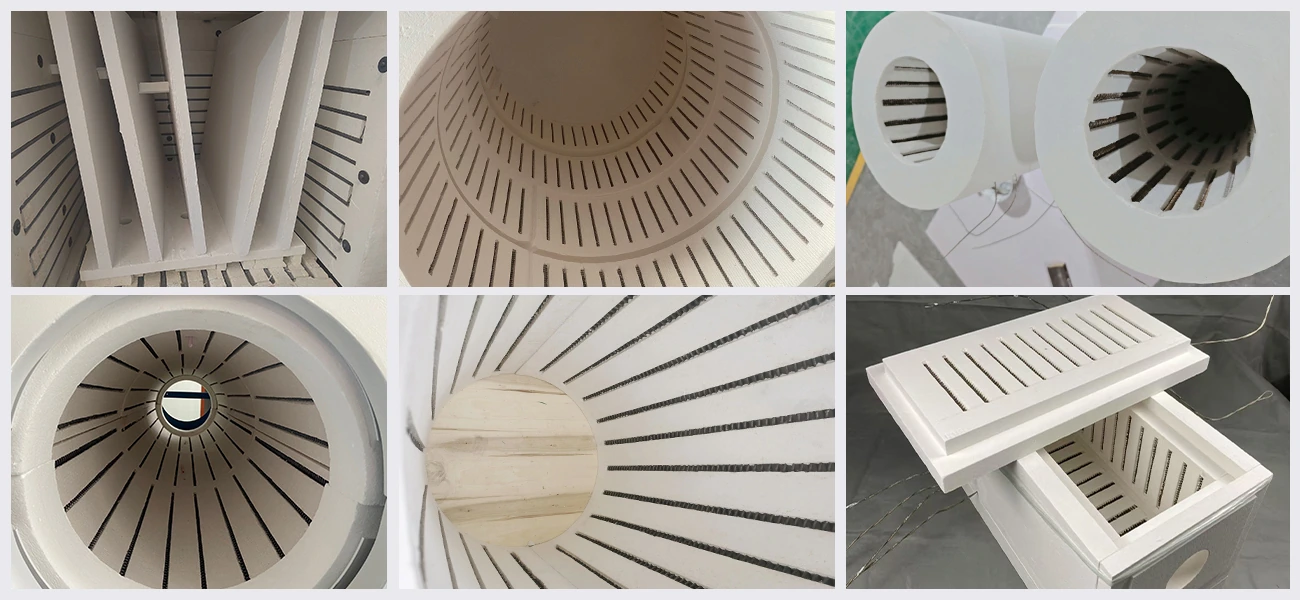
Ceramic fiber heating modules

Online Message

姓名*
公司
邮箱
电话
留言信息
正在提交!
提交成功!
提交失败!
邮箱错误!
电话错误!