xuye
xuye全站搜索
Search the entire website
整站搜索产品中心新闻中心
点击开始搜索
热门搜索
UltraForm-MXFlexiPoly-RNanoForm Z300EcoFab P200
Search the entire website
A CVD (Chemical Vapor Deposition) tube furnace is a specialized device built around a high-temperature tubular chamber, coupled with a precise gas flow and vacuum system. It enables vapor-phase precursors to react chemically on substrate surfaces, depositing thin films, coatings, and one-dimensional nanomaterials. Its uniform temperature field, wide process window, flexible sample loading, and relatively manageable cost make it widely used in laboratory R&D and pilot-scale trials.
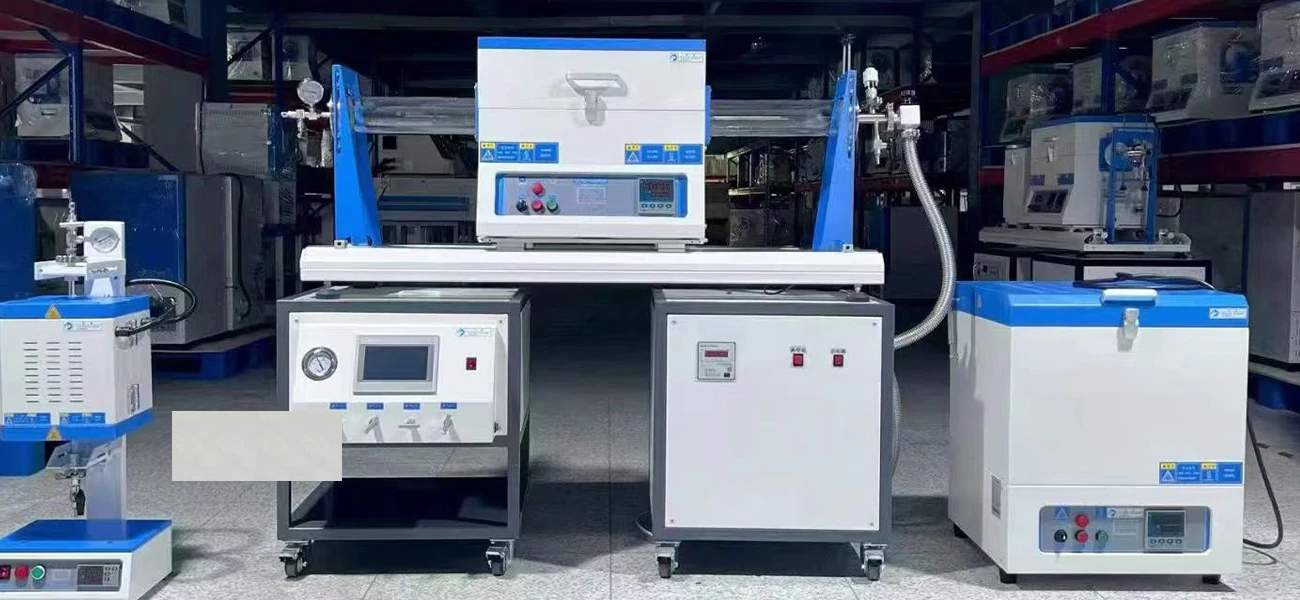
The basic concept of CVD is to mix one or more vapor precursors containing metal/nonmetal elements (which can be gas or vapor) with a reaction/dilution gas in a proportional ratio and introduce them into a tubular chamber heated to a set temperature. On the substrate surface, the molecules are adsorbed and undergo reactions such as thermal decomposition/reduction/oxidation/nitridation/sulfurization, resulting in the deposition of solid products as a film. Simultaneously, the generated byproducts are discharged with the exhaust gas.
Key Process Elements:
Supply: A mass flow controller (MFC) provides a stable gas supply. Vapor precursors require a vaporizer or heated pipeline.
Transport: Gas-phase mass transfer is affected by total flow rate, pressure, carrier gas type, and temperature gradient.
Surface Reaction: Substrate temperature, surface active sites, and precursor decomposition pathways determine deposition rate and density.
Exhaust and Purification: Vacuum/low pressure minimizes gas-phase side reactions; exhaust gas is treated through combustion/absorption/adsorption.
Typical Structure of a CVD Tube Furnace
Heating Furnace: Single/multi-zone resistance heating, insulated with fiber/lightweight bricks; temperature control via PID and thermocouple closed-loop control.
Furnace Tube (Reaction Chamber): Common materials include quartz (transparent and clean), corundum Al₂O₃ (high-temperature corrosion resistance), and SiC (thermal shock resistance); with sealing flanges at both ends.
Gas System: MFC, needle valve, check valve, switching valve, gas mixing manifold, line heater, and precursor evaporator.
Vacuum System: Mechanical pump/molecular pump (required for low-pressure CVD), foreline valve, and pressure sensor (Pila/Pirani/capacitive diaphragm).
Pressure and Flow Measurement and Control: Backpressure valve, vacuum gauge, and closed-loop mass flow controller.
Slide Loading and Slide Carrier: Quartz boat/graphite boat/porous substrate holder, also capable of rotating or push-pull loading.
Exhaust Gas Treatment: Combustion/plasma pyrolysis, acid/base scrubbing, and activated carbon adsorption to ensure compliance with emission standards.
Safety Interlocks: Interlock shutdowns for overtemperature, overpressure, air leak, water outage, power outage, lid/flange opening, and vacuum failure.
Working Principle and Process Flow (Schematic)
Sample Loading and Vacuuming: Load substrate → Seal → Vacuum to target pressure or replace with inert gas.
Tempering and Stabilization: Ramp temperature according to recipe (steps/ramp) → Temperature and pressure stabilize.
Feed Reaction: Start the precursor and reaction gas (e.g., H₂, NH₃, O₂, H₂S, Ar/N₂, etc.), maintaining a constant flow rate/ratio/pressure/time.
Cooling and Passivation: Stop the precursor and cool with inert gas; perform post-processing (annealing, oxidation passivation) if necessary.
Sampling and Characterization: Evaluate thickness, refractive index, composition, stress, roughness, and density.
Common Classifications and Application Scenarios
Atmospheric Pressure CVD (APCVD): Simple equipment and high throughput; film density and uniformity are significantly affected by gas-phase side reactions.
Low-Pressure CVD (LPCVD, 10⁻¹–10⁻³ Torr): Excellent film uniformity and low-temperature deposition are possible, but higher requirements are placed on sealing and pumping systems.
Plasma-Enhanced CVD (PECVD): Uses plasma excitation to lower the deposition temperature and is suitable for organic polymer substrates or temperature-sensitive materials.
Metal-Organic CVD (MOCVD): The precursor is a metal-organic compound and is suitable for Group III–V compounds, oxides, and nitride films.
Hot-Filament CVD (HFCVD): A hot filament decomposes gases (e.g., CH₄ → H·) and is used for the preparation of diamond-like carbon films and nanodiamonds.
| Model | YX-1700C |
| Maximum temperature | 1650℃ |
| Continuous operating temperature | 1550℃ |
| Tube size | Φ25/50/60/80/100*1000mm |
| Furnace chamber material | Ceramic fiber products |
| Recommended heating rate | Below 1400℃≤10℃/min, 1400℃ to 1600℃≤5℃/min |
| Temperature Control Method | Fuzzy PID control and auto-tuning; intelligent 30-segment programmable control; over-temperature and burnout alarm functions |
| Heating Zone Length | 300mm |
| Constant Temperature Zone Length | 150mm |
| Temperature Control Accuracy | ±1°C |
| Furnace Tube Dimensions | Ø60/80*1000mm (diameter optional) |
| Heating Element | Silicon molybdenum rod |
| Standard Accessories | 1 high-purity corundum tube, 2 pairs of alumina tube plugs, 1 set of stainless steel flanges, 2 sets of fluororubber sealing rings, 1 pair of high-temperature gloves, 1 crucible hook, 1 small fuse |
| Sealing System | Both ends of the furnace tube are equipped with stainless steel sealing flanges (including precision needle valve, pointer type vacuum pressure gauge and hose type pagoda nozzle joint), and the port can be expanded according to actual use |
Online Message