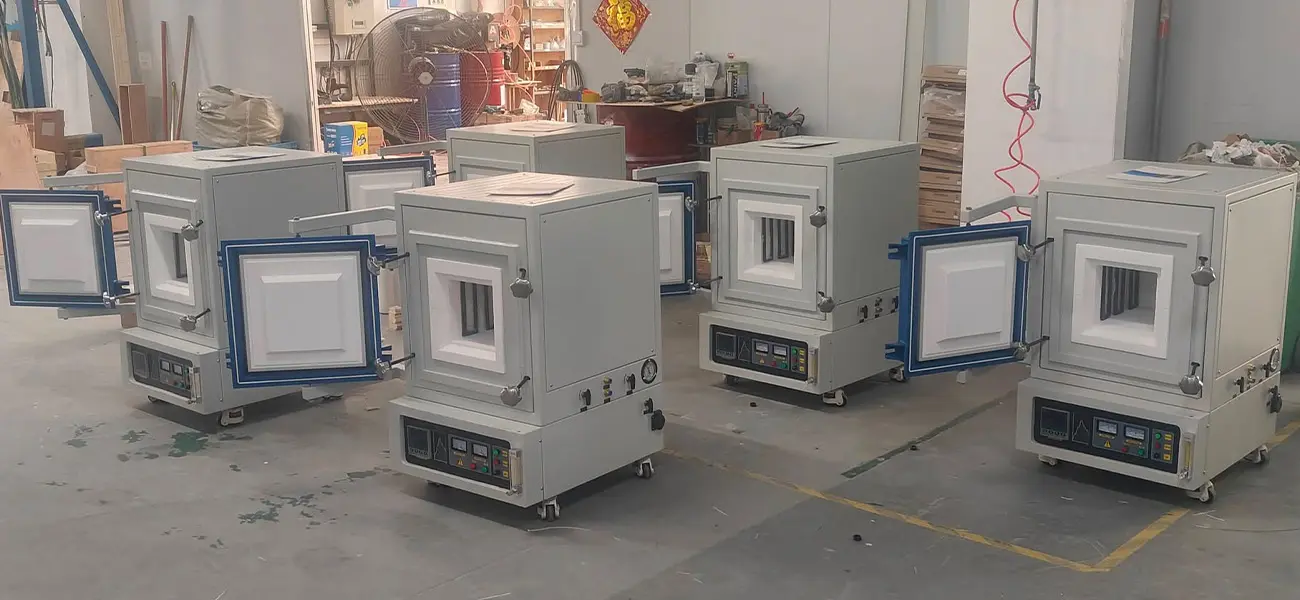
The function of the laboratory muffle furnace has been further expanded to special atmosphere treatment and customized process scenarios. In the research and development of new energy, it is used for nitrogen protection sintering (to prevent oxidation) of lithium battery positive electrode materials and high-temperature synthesis of solid electrolytes.
TEL+8618836556085
Laboratory Muffle Furnace
A laboratory muffle furnace is a high-temperature, front-loading or box-type heating device that isolates samples from combustion byproducts using a refractory “muffle” chamber. Unlike tube furnaces, a muffle furnace offers a square/rectangular chamber for batch processing of crucibles, ceramics, metals, and materials that require ashing, calcination, annealing, heat treatment, or loss-on-ignition (LOI) testing from roughly 300 °C up to 1,800 °C (model dependent).
How a Muffle Furnace Works (Principle & Structure)
Heating Elements Common choices: Kanthal (FeCrAl) for ≤1,300 °C; Silicon Carbide (SiC) for 1,400–1,600 °C; Molybdenum Disilicide (MoSi₂) for 1,600–1,800 °C. Elements line the chamber sides, top, or back for uniformity.
Insulation / Chamber Lightweight vacuum-formed ceramic fiber or alumina refractory bricks provide rapid heat-up and low thermal mass. The “muffle” shields the load from direct flame or element contamination.
Temperature Control A PID controller with a Type K/S/B thermocouple regulates setpoint. Advanced models offer multi-segment programs, ramp/soak profiles, and data logging via USB or RS-485/Modbus.
Airflow / Off-Gas Optional air inlet and exhaust port support ashing and LOI. Some units accept HEPA/activated-carbon traps or connect to lab ventilation.
Safety Door interlock, over-temperature limiter, circuit protection, and insulation cool-touch exterior. Many models are CE/UL compliant.
Typical Technical Specifications
Parameter
Entry Level
Mid Range
High Temp / Research
Max temperature
1,100–1,200 °C
1,300–1,400 °C
1,600–1,800 °C
Chamber volume
1–5 L
5–20 L
1–10 L (high-temp)
Uniformity
±5–10 °C @1,000 °C
±3–5 °C
±2–4 °C
Heat-up rate
10–20 °C/min
20–30 °C/min
20–40 °C/min
Elements
FeCrAl
SiC
MoSi₂
Controller
Basic PID
Programmable (8–30 segments)
Programmable + comms
Power
110–120 V / 220–240 V
220–240 V
220–240 V / 380–415 V
Options
Crucible set
LOI kit, air inlet
Inert gas kit, data logging
Key Applications
Ashing & LOI (ASTM/ISO methods) for foods, coal, biomass, polymers, cements.
Calcination of powders, catalysts, phosphors, and ceramic materials.
Material Characterization: thermal stability, binder burn-out, mass change.
Dental & Jewelry: burnout of investment molds (model dependent).
Metals/Alloys: oxidation studies (note: for carburizing/nitriding or scale-free work, consider tube/vacuum furnaces).
How to Choose the Right Laboratory Muffle Furnace
Temperature Class
≤1,200 °C: General ashing/LOI, education, routine QA.
1,300–1,400 °C: Ceramics, advanced calcination.
1,600–1,800 °C: Research-grade sintering of high-alumina, zirconia, or advanced oxides.
Chamber Size & Loading Pattern Estimate batch mass/volume + crucible height. Leave 10–20% free space for airflow. For tall crucibles, prefer a tall-chamber model or removable shelf.
Uniformity & Element Layout Multi-sided elements improve uniformity and ramp rate. Ask for a temperature uniformity map at your target setpoint.
Controller & Data Need ramp/soak, multi-program storage, USB/RS-485, or PC software? This matters for regulated labs and method reproducibility.
Atmosphere Needs Most muffle furnaces are ambient air. If you need inert or low-oxygen conditions, confirm availability of a gas-tight chamber or consider a tube furnace with sealed quartz/alumina tube.
Exhaust & Filtration For organics burn-off, choose exhaust stack, adjustable air inlet, and plan proper ducting to your fume hood.
Compliance & Safety CE/UL labeling, over-temp protection, door interlock, and cool-touch exterior reduce risk and support audits.
Total Cost of Ownership Factor element life, insulation durability, spare parts availability, and energy consumption (insulated fiber chambers typically save power).
Operating Best Practices (Quick SOP)
Pre-Checks: Inspect elements, door seal, thermocouple position, and chamber debris.
Loading: Use alumina or corrosion-resistant crucibles; avoid direct contact with elements. Keep samples centered with air gap around them.
Programs: Use ramp/soak to avoid thermal shock. Common LOI: 105 °C dry → 550–600 °C ash (per method).
Cooling: Program a controlled cool-down; do not open at red heat to protect insulation and elements.
Cleaning: Vacuum cold ash; place drip trays for binders. Avoid chlorides/halides that attack elements.
Calibration: Annual temperature calibration and uniformity survey for QA labs.
Maintenance & Troubleshooting
Elements dim or open-circuit → Measure resistance; replace in matched sets for uniformity.
Slow ramp → Check supply voltage, element aging, or insulation damage.
Poor uniformity → Verify door seal, load spacing, and thermocouple location; run an empty-chamber uniformity check.
1400 °C Programmable Muffle (10–12 L): Ceramic calcination, dental burnout.
1700–1800 °C Research Muffle (1–4 L, MoSi₂): Advanced ceramics, solid-state synthesis.
FAQ
Q1: What temperature do I need for LOI or ashing? Most methods specify 550–600 °C (organics) and up to 815–1,000 °C for certain residues. Check your governing standard.
Q2: Can I run inert or reducing atmospheres? Standard muffle furnaces are for air. For precise atmospheres, choose a gas-tight muffle (rare) or a tube furnace with sealed tube and gas control.
Q3: How long do heating elements last? Dependent on chemistry and cycles. Typical ranges are 2–5+ years in routine air service when kept within rated temperature and clean conditions.
Q4: Why does my LOI vary run-to-run? Common causes: moisture control, inconsistent ramp rate/soak time, crucible cleanliness, chamber uniformity, and balance calibration.
Q5: What’s the difference vs. a tube furnace? A muffle furnace is better for batch work with trays/crucibles and simple airflow; a tube furnace excels at controlled atmospheres, flowing gas, and long slender samples.
 xuye
xuye